anthología
of lovers and monsters / of myths and blood
If you ever wondered about the characters and stories that inspired many illustrations, tarots and studies, you've come to the right place: for context, for a written content behind the visual one - here you can find a piece of media made out of something that never really existed.
If you wish to know more about our worlds, friendly rebranded as Myths and Monsters, explore the sections above - MYTHS for stories of gods and demigods; MONSTERS for stories of...libraries and librarians.
This may sounds very pompous, but worry not: the vampire in the library keeps losing the buttons of his shirt, the son of the greek Messenger has a moving ox tattoo (and a caffeine problem), the pianist who only wears pink has low blood sugar and the demon in the church attic is still looking for their basilisk leather shoes - they're all really lighthearted creations.
...All things considered, maybe some content would be better WITHOUT context...
inspiration
As a starting point, the stories you are about to learn did not spurr out of pure nothingness, as original content never tends to be.
The origin of the settings, adventures and situations recounted in these pages can be found in a set of table top rpg games. No, not Dungeon&Dragons but there is still dice rolling and stat checking.
For the Myths section of this Anthologia the inspiration was the Quickstart Powered by the Apocalypse Demigods game; For the Monsters, the game of inspiration was Monster of the Week.
Both manuals are linked below, if you ever get curious and want to try your own version of them:
myths
Every Legend has a layer of Reality in it... but have you ever wondered where that line lies?
What if the line of truth is far further than where you thought it was?
Myths takes place in a world where Gods and Legends are true. All of them at once... mostly!
Every religion that has been followed for enough time and enough conviction finds its realization in the multipantheon of this world, each divided by domain and location (you'd never want to step on your "colleagues from another division" 's feet).
Gods' powers rely on Faith, Belief without Evidence: if enough humans knew about the existence of one God over the ten thousands other Deities, a Divine War would soon follow between Pantheons to score and hoard more worshippers (and consequently more power). Therefore most of them decided to lay back and lay low and delegate some of their duties to human children they elevate (biologically or by adoption) to the status of Demigods - those little heroes are the protagonists of our stories.
Disclaimer:
Every major cult has been introduced in this world as a concept but the stories hereby told are focused on the Mediterrean area with sporadic appearances from Norse Deities: we are more comfortable exploring those since Classic myths have always been part of our education, so we have studied them in literature classes and researches. They are part of our heritage and we had the chance of getting to know them better!
1500
The date dances around the year 1550, and the place is the oddly named, oddly founded, oddly constructed Outsidetown (Fuori, in original language), located less than half day's horse (normal horses, of course) from The Republic of Venice.
In a smithy workshop that also functions as oddity serial hoarder, a Weave of Demigods keeps collecting contracts and Favours from the most unexpected individuals. Yesterday the Sun gets locked out his special Garden, today the God of Seas and Oceans is looking for his daughter, tomorrow... who knows!
The looming threat in clerical red clothes of the Holy Inquisition is relentlessly hunting down the demigods who couldn't form a Weave - alone and outnumbered, these unlucky teens keep disappearing never to be seen again.
Between investigations and fights, the Weave of barely adults is not safe from ridiculous shenanigans.
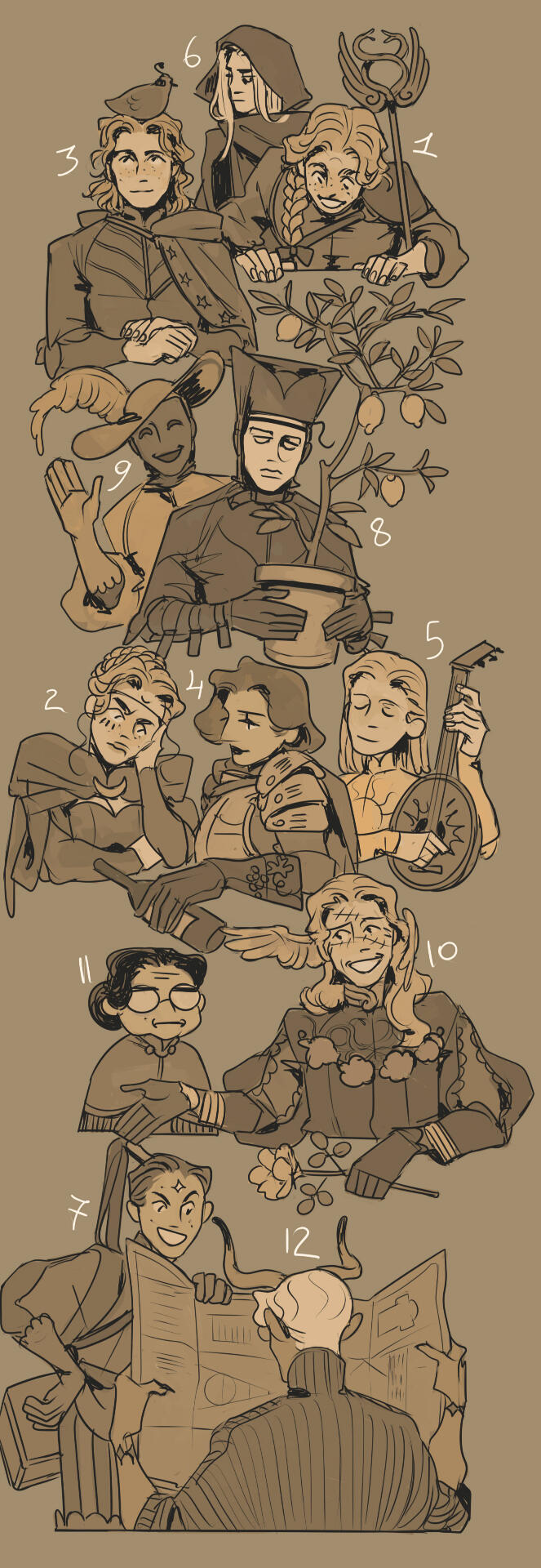
1. Scipione Mastrosettimo Vi, 19, Son of Hermes, Artificer (the Talkative Tinkerer). Losing his father to the war and later on his mother to illness, Vi was left alone with his sister in their parents' shop. Alone not for long since Hermes jumped down at the first possible occasion to take care of the two kids, and they all have been living together in a magically enhanced building (the Workshop) since then.
NB: Hermes "depowered" himself into being almost a human to stay unnoticed on Earth and be closer to his child(ren).
2. Serafina Mastrosettimo, Saffo, 19, Daughter of Artemis, Reaper (The Thoughtful Thinker). Saffo has been "adopted" by the distant Artemis a little later than his brother and Hermes, mostly because the Huntress didn't fully trust the Messenger with two kids alone. Saffo was meant to be a Verdant, but the plague's years bent her aptitude to the Reaper, although she doesn't actively work in that grim field.
3. Velasco Turno, Quaglia (Quail), 20, Son of Asteria, Verdant (the Timid Tracker). His human father fell in love with the Starry night one evening he was out to get nocturnal plants for his pharmacy. The son followed his father's footstep becoming a pharmacist as well, under the mentorship of the mysterious Cerusico, who brought him to Outsidetown where he met the Weave.
4. Arianna "Giudici", 21, Daughter of Dionysus, Warrior (The Thorny Tank). Her mother is an unknown nun that met her father while working in the vineyard. At her birth, she was sent to another monastery where she grew up. Her Father found her and helped her leave that pious prison. She lived most of her life as a silent, always helmet-ed, gun and sword for hire.
She is immune to poison and good decision making.
5. Orfeo Guadagni, 16, Son of Apollo, The Muse (the Talented Teen). Born of a rich family, he didn't know of his godly origins until Hermes found and informed him of it, for Apollo is rarely involved in the lives of his children. He's the youngest of the Weave and thusly the one that gets left at the safe home for more dangerous missions (especially those ones that involves Maenads - to avoid the same fate of his homonym fellow poet).
6. Oswald: differently from Saffo, Oswald is a Low-westphalian young man who looks colourless. He intimidates humans with his otherworldly presence, as if they knew he was actually one of the active Grim Reapers of the area. He is son of the Divine Ferryman, and helps them and his uncle Thanatos in their work.
7. Timoteo: Tim's life has been quite a rollercoaster, if only the thing existed back then. Once a pirate (deckhand), then the town's bard, then the jail's bard, he ended up working for the local church...'s cryptid. Nowadays he's so kindly helping a poor elder architect out, doing chores and dusting books in the old man's hidden observatory for all eternity. He must have done something unforgivable to deserve such punishment. Wait, whose deity is Tim son of?
8. Cerusico: a silent medical expert that helped Hermes once and stuck around to help Vi with his magi/medical issues. He wears full covering black clothing, gloves, tall hats and an unexpressive white mask. He's dedicated to his craft. Life gave him one very needy plant of lemons (Citrus).
9. Factotum: a talkative...jack of all trades, who seems to enjoy being a bother to doctors people way too much. He's been actually quite helpful, but also as mysterious as the local masked doctor. Which is a lot.
10. Hermes: A deity shouldn't take as many leaves as this one, but somehow the Greek Pantheon doesn't complain when the disaster Messenger disappears for five or more decades. He's expertised in troublemaking, after all, and opening a Workshop to local entities in trouble sounded just right. As it did adopting some twins, stealing one more cow (Beatrice), messing with the town's council and, uh, the Inquisition. Somehow, his hair are always perfectly soft.
See the Expanded section for proper info (on the deity, not his curls).
11. Peppina: just a tailor, ancient woman that took care of the twins quite often in the years. She always seems to know too much. She's exceedingly short and wears comically large and thick glasses. Her shop is amusingly expensive, but she occasionally accepts favors instead. (Also her cakes are so pricy that only chosen clients can partake of them)
12. The Architect: they've had many names and faces, so their job really is the easiest way to address them. No, they didn't take part in the Creation of any universe, but they DID take lead in the building of a temple. Many temples, as architects tend to do from time to time. They had quite the fun working on the town's cathedral, so much that they decided to move their hidden sanctuary in the church's attic. They claim to be helping the Workshop in mysterious ways.
Godly Parents: Asteria: despite being heavily over-worked, she always watches over her son and keeps giving him tips and hints. For Artemis, Dionysus, Apollo, Febo, Caronte: See the Expanded section.



1800
In quaint mid 19th century London, two demigods share a rented attic in an old but kind woman's home. One is an opium addicted, hot headed thief freelancer, scientist and engineer ; the other is a calm, cold, collected, serial hoarder, body-snatcher budding PhD chemist and poisoner.
After discovering each other's secret half godly nature, the two started begrudgingly cooperating for questionable scientific experiments and god-requested fetch side jobs. They keep stumbling upon various major war-causing schemes that they not very expertly thwart with the help of a mutual demigod biologist friend, witnessing with their own eyes that a superior will is pushing those diplomatic "accidents".
But a way more sinister and unknown power is lurking away from their sight, in the folds of Reality, shaping something dark from the Far Beyond...
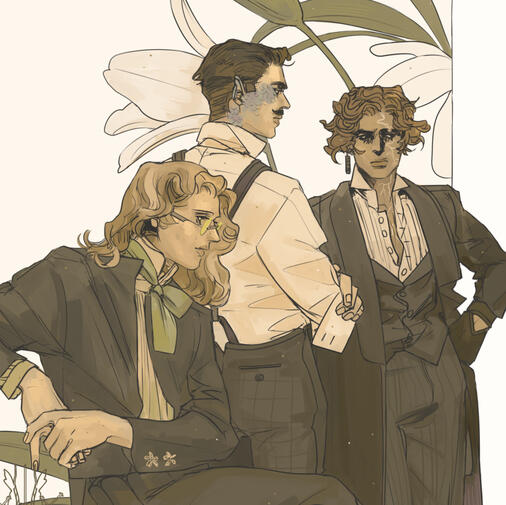
Matieu and Adam: This explosive and warmongering duo composed by the sons of Mars and Ares has been (for now) the main semi-godly antagonists of this story
Maeves: not a demigod officially, she gains powers from the favours both Aphrodite and Venus make her out of esteem, since she really is a woman up their alley (they are both trying to claim her as their daughter). She uses many aliases and almost nobody knows her first name. Nobody her last.
Giorgione Casanova has been cursed with a dark Sight. Biologist, druidic son of Hermes, born in a resilient twisted cult that re-emerges every two centuries or so, he lives in an isolated cottage in the countryside of the London County with his adoptive father and a huge wild cat, Terror, that has sort of adopted him as well way back when he was a child. Wait...how long do normal cats live??
Dr Theseus M. Pelagio is son of the Oceanid Styx and has a spotty scaly skin he calls "a medical condition" to fellow humans. He is a chemist, specializing in inorganic matter. He tends to be way too forward with his scientific discoveries and the unorthodox use of magic forces him to make ends meet with not totally up and up activities (such as selling dubious obtained bodies for medical studies etch...)
Celeste Corso, called Cece by Giorgione and Corso by Pelagio, is the belligerent redhead son of Hephaestus, from who he inherited the artificer aptitude but not the artificer attitude. He is impatient and unwilling to take any shit from the "more learned" of him (promptly calling them wiseguys before decking them): these characteristics made him "unfit" for academic life, but still he dabbles in overly complex and way out of time machineries and engineering creations.
Terror is the "chosen" name of an enormous wild cat that is way more than he appears to be. He lives in the cottage with Giorgione and (not enthusiastic) Hermes. He stays there because apparently Hermes got there too fast to firm the adoption papers, and the mysterious not-totally-just-a feline had some plans for Giorgione And wants to see where all of this will end up to. He sautners around the property pretending he doesn't enjoy the two men's companionship and his life as a cat.
As cats are known to do.
2020
It's the current decade of the current century, after an almost successful invasion from the Cosmic Horrific Deity Lady Hydra and her army of Deep Ones of the sacred Fire Sanctuary, in the middle of Aegean sea, a museum and place of religious power that collects and hides almost all Origin Flames (including Prometheus' fire and other lights of human ingenuity).
This successful thwarting by a comically large and eclectic group of demigods convinced Hestia and Vesta amongst other Gods to bless the union of this ragtag Weave of Heroes.
A year later some disturbing extraterrestrial creatures incursion and the rise of a suspicious group bent on attacking demigods, our Weave is mostly vibin' and chillin' fixing uncommon problems here and there and generally just going where the Fates seem to push them.
Clarification:
This was the first of our worlds that we explored and expanded, therefore its more tied to other people's imagination and their creations: the basic idea and setting belongs to a GM friend of ours, and so five out of seven members of this Weave belongs to other players.
The stories and details here written concern mostly our two ocs and Deities that have not been established or described by the GM or the players.
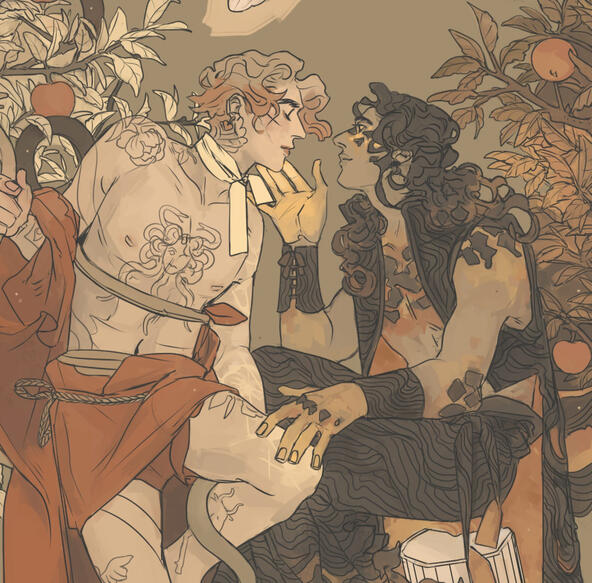
Tiziano Rosso: Son of Hermes, is a venetian art and antiquities "licensed" merchant whose headquarter is in an apparently abandoned small church on a lost island in the mediterrean sea (the door gives way actually to a Safe Sanctum multiple times larger and more intact than its exterior look).
He dresses in punkish variations of reds and blacks and is heavily tattooed. He's a wizard specializing in portals, gravity and glass manipulation.
He's sociable as a human cactus and is prone to Bad decisions.
Furio Orlandi Lando: Son of Adranus (described in Expanded at the Vulcan entry), is a sicilian fetchboy for the Roman volcanic Deities. He lives in the attic of his firefighter mother's house, in whose basement lives also Lando's grandmother and her "long life girl friend" who's a proper village witch; they own many farm animals. He's ridiculously tall and also colourblind and wears terrible patterned shirts (constantly half opened on the chest).
Zesthur Kaiwan: Son of Hastur, Cosmic pantheon. He's a manager in his mother's company and only wears yellow suits.
Meadow Ambrosia Moser Misia: Daughter of Persephone and a hippie mortal mother who raised her on stories of her godly mom.
Suzuki Nova: Daughter of Hecate, half-japanese intern at Nasa.
Tachibana Hikari: Daughter of Amateratsu, left in the care of her mother's priests back on homeland.
Lydia E. Ariesti: Daughter of Hel, reaper and powerfully goth girl.
Hereby we will offer a written description of the recurring deities and the "overlapping" ones from the Roman and the Greek Pantheon. We present to thee... The Demigods Extended Universe!
Dexu
Greek Gods act and are more like a family, and they behave similarly of what we normally know from mythology passed down.
Roman Gods act more like a company, a work setting, for most of them come in from different assimilated pantheons like Febo and Silvanus come from the Etruschian and Proserpina from the Sicilian cults, and some are taken from the Greeks as well.
The Primordial gods and personifications are the same individuals for both Pantheons (Chaos, Eris/Vendetta, Nyx/Nox ...) and they use both names most of the time.
Olympus is, yes, up the original mountain but it's more “everywhere” and since the Romans added their ‘diverse’ worshipping, the original kingdom expanded - mirrored but slightly different - separated with a tall flowery edge that appeared at the eastern corner of the original acropolis.
It’s extremely rare, more unique, to see the Gods cross the only gate available; the only ones that have no regards for the separation are the Divine Messengers who frequently cross and mess up the edge in the process (on purpose probably) or play badminton using the border as a net, and the Gods of Wine, that have cut a large “window like” open in their respective large backyards to set up parties at the same time.
The Roman side is called The Foro.
Zeus and Jupiter have a similar role in the pantheon, of course, and both fathered many children in their prime time (when they were openly worshipped). Now they are both more on the low profile side, for their children tend to be way too noticeable. Zeus is a proud lewd older man, with a classical cloudy beard and a powerful muscular body, while Jupiter tends to be more refined and modern even if that comes across as a trashy copy of a playboy magazine front model. The former maintains his habit of indulging himself with nymphs and other deities while the latter grew more faithful of his intimidating wife, for Roman Matrons were held and always will be held in higher consideration.
Hera is an austere and proud, stoic and firm older woman with a couple of solid white locks held firmly in a tight and complex hairstyle and she keeps her attire mostly similar to what it used to be back in the glory days - she looks like a solid marble column given life. She’s distant and cold but her fury still has the Olympus rattle. Juno is a large, soft woman, with incredibly voluptuous curves and large son-bearing hips, often wrapped in very stylish black long dresses. She “Dress to Impress”, MET GALA cowers at her. She’s more mild mannered than her Greek counterpart but only because she finally got her husband under her very pricy heel. She’s the one with the pants in the House, and the entire pantheon reflects on that aspect.
Both generally good-natured, they took on the “all year beach” time to heart: Poseidon is rarely wearing pants, and Neptune is rarely out of the sea altogether. They … are not the brightest trident in the shed, and generally mind their business. They pretend to hate each other when they are around other gods but actually really find each other’s company a nice summer breeze. Poseidon keeps to the surface waters while Neptune prefers the dark belows, so their bodies and colour palettes respect these location choices, where Poseidon is tan with long watery hair and Neptune is more fishlike, with white vitiligo on a darker skin and some accents of fluorescence.
Demeter and Ceres found an agreement in sharing their natural domain, one specializing in wild nature and the other cultivated lands. Demeter is a serious individual who is still pretty much hung up over that Kore debacle, while Ceres is very enthusiastic about her daughter's "new" place in the world. Demeter tolerates the ostentatious good-tempered nature of Ceres so Ceres indulges Demeter’s need to talk shit on people’s back, for she’s more than happy to oblige the flow of gossip. They oft drink tea together in one of the minor caps of the Olympian mountridge. Both change their apparent age during the year, keeping a more severe and older look in the cold months and slightly more youthful in the warmer ones.
Hades detests trousers, you will NEVER see Hades in a pair of two legged pieces of cloth, so he varies between official greek regalia to modern day women’s dresses, which fit him in a weird way but strangely very good. He’s ashen in appearance and has dark Long hair which changes between straight or crispy based on his humor or feeling for the year. He takes his job very seriously but not as seriously as Dis (or Dis Pater) who never leaves the House: he’s more in the likes of a 60s businessman, pinstripe waistcoat, white collar shirt (always with sleeves up his elbows) and very fancy very expensive shoes, for he’s also the God of Wealth.
Nothing much has to be said about Hestia and Vesta, who embody the traditional mediterrean “angel of the hearth” look, where one is softer and the other stronger, they mind their domestic business chatting at the distance of their different home’s windows like a couple of older italian ladies. Their homes are the direct entrance to the Cradle of the Fire, a powerful resting place in the Nowhere of the Mediterrean sea where all primordial Fires are kept secret.
In the 21th Century some outsiders from the cold cosmos attempted to steal and snuff all of them at once but an unexpected band of ragtag demigods who "casually" (nudges the Fates a bit) found themselves there stopped the act before it was fulfilled and therefore Hestia and Vesta blessed their union as a Weave to allow them to keep acting in protection of the Fires.
Athena and Minerva have a really different approach to life because Athena still feels pretty much like she belongs to the people of her Namesake City and has a lot of pressure (often self imposed) on her shoulder. Minerva is content to just deliver and dispense council wherever she sees need of it, allowing her more belligerent side to not be overfed by the already constant wars in the area. Athena has been influenced by Ares far more than she’d admit, especially after the dark war times of the 20th century, where the Gods of War had a field day. Athena's patience has grown thinner over the last millenias and she is still a force to be reckoned with; Minerva acts more like her meeker sister, but her rage is more often than not expressed via subtle but sadistic petty revenges.
It is needless to say that the Gods of War are thriving in these wacky modern times: they have been both on a high roll since the start of the 19th century and have been up there since, even though the major conflicts have moved off European land (where their influence generally extends to). Mars is a cold warhead, extremely well-spoken individual who is not above writing slightly disturbing but utterly beautiful war poetry, while his greek counterpart Ares prefers a wilder approach, far more violent and bloodthirsty - he is almost a caricature brute with little to no interest in the finer arts.
Despite this different approach to War they both benefit from each other’s continued company, being amongst some of the closest individuals from different pantheons.
Their cooperation is to be feared and monitored with care. Usually Athena and other kin minded colleagues fall in this role.
Gods of the two different pantheons usually span to a range of friendliness to neutrality to their counterparts, but the Goddesses of Beauty and Love flicking hate each other.
There is not a meeting or a chat between them that doesn’t end in blood or in a handful of hair pulled in someone’s hands: it’s a constant war between the two like it has been the Golden Apple debacle for the past 2000 years, and an eventual meeting of the two has become the most dreaded possibility for both Pantheons.
The Goddesses' unspoken beauty contests forces them constant change and never set on a specific gender representation, and their unending struggle for the title of Best reflects really easily on the everchanging and impossible beauty standards of the society below. Most days it stops at fashion choices but on the worst moments their rivality places so much passive pressure on humanity and, more often than not, many individuals cave in and surrender their lives. Venus and Aphrodites’ war constantly claims victims, and they unconciously thrive because of it.
Both Queens of the Underworld switch in two different personalities during the year:
Persephone is Regal in her winter days and Princely in her summers, alternating dark and reds to creams and greens. Flowers are her main manifestation both outside and inside the belly of the earth and she’s firm as a Queen and relaxed as a Princess, with her long earthy brown hair/eye/skin colours and flowy dresses.
Proserpina is Motherly in winter and Carefree in summer, changing her personality depending on her status as a wife or a maiden, and her themes are more specifically fruits and goods, and her passage is shown by the presence of filled up cornucopias, ripe trees and fruit baskets. She’s a touch more extroverted than Persephone who enjoys her rare visits but is often left with little energy to socialize with others for Proserpina is a proper Sicilan Lady™.
Apollo and Febo share one thing that is impossible to ignore, and that thing is their enormous ego. For all of the years of indirect worship to the “Arts”, Both Apollo and Febo benefited from it (Febo's less used name is Apul, which led to an interesting overlap of prayers from desperate artists in search of inspiration). Nowadays they still enjoy a pretty extravagant and rich existence, now and then gifting temporary clairvoyance to unsuspecting humans only for the little chaos of it, and the subtle surge of believers every time something unlikely happens just as “user name from hell site predicted”. Their sense of self worth only grew with time, making them rarely tolerated by their peers and rarely loved by their children, who often are left forgotten or unattended and suffer from their fathers’ absence.
Nowadays the Huntresses are more reclused than they used to be back in the glory days: hunting is a mostly gotten over with activity that their services are seldom required or asked upon and they both decided to mostly disappear in those little wilderness spaces left for them. Artemis is slightly more available for her twin Apollo always takes a bit of his impossibly precious time to force her to not totally give in in her wildling nature, and she actually secretly appreciates it, while Diana is far more removed from the world altogether, only picking up -kind of inexplicably- Mercury’s calls to plan pranks on the authorities.
Diana (in her Luna form) had been chosen up by some modern pagans and wiccans as worshipped Deity and she gladly extended her blessing to those little cute witches of hers.
People often confuse the different pantheon gods with themselves but no one has a more difficult time than Eros and Cupid: Different origins and stories are given to the God of Love in modern times and they are all true, if you carefully study the differences between those two winged deities.
Eros is a Primordial God, been there since the start of times, spawned almost immediately from Chaos and Nyx and has walked the earth for untold millenias: he is an handsome brown skinned man with impenetrable pink eyes and long lashes, who’s primordial powers dwindled in time but is still pretty much operational and online.
Cupid is the son of Beauty and War, namely Venus and Mars, (people often think Eros has a similar origin where it is not the case). He prefers to appear as a young man or late teen, with the classical angelic blonde curly face and diminutive soft bird wings. He also kept most of his powers from the golden times and delegates most of his work to his “little birds” who also acts as informants, for he is a huge gossip. He is married to his peer, Psyche.
Eros and Cupid have a competitive and slightly spiteful relationship but they do not avoid each other nor refuse to help the other when in need.
No one on Olympus found as a strong kinship in their counterpart as Hermes and Mercury did with each other. It took awhile for (one of) them to officially accept the title of brothers but their friendly familiar relationship was evident from day one, when first the roman Messenger appeared on this earth. A friendly familiar relationship that the rest of the Pantheon still fear and regret, for the mischievous tricksters are always up to no good when they are together. They used to have a different appearance but with time they unwittingly morphed into the likeness of each other to further consolidate their twinship and are the only ones that openly defy the no-trespassing rule set between the two pantheons.
Nowadays they both discarded their psychopomp duties to either slack off (both), meddle with human affairs (both) or raise human children (Hermes), be a nuisance to their peers (both), or be a weirdly omni present merchant just all around the world (Mercury).
They are both well versed in disguises but Hermes will always have flip flops or discrete wings decoration on the shoes and Mercury socks (yes, with sandals too).
Hephaestus and Vulcan would be called good friends who hang out a lot, if either of them was willing to leave their Forge for more than five hours each time. After his (fifth) divorce (with the same woman) Hephaestus decided to dedicate himself fully on his craft, partially abandoning the weapon forging department and focusing more on the minute metalwork, clock making, fine machine building, while Vulcan moved owards heavy metallurgy, factory machinery, building and vehicles construction.
With time Hephaestus acquired a young artisan ascended godling as assistant and had finally the time to indulge in rare walks outside the forge- PSYCH!! That’s absolutely false, Hepheastus would never ever walk out. He has bad legs and no interests.
Vulcan has had an associate with the dawn of times, in the form of the Elemental God of Etna, Adranus, who lived in the vulcan before he set his forge there. The sicilian God was more than happy to join forces in a creative effort. Despite his protective role and nature, Adranus is quick to anger and once unleashed ...well you can guess the rest. Thankfully Vulcan’s strong patience softened a bit the volcanic deity’s temper.
As previously mentioned in the intro, Dionysus and Bacchus are the other two Classical Gods with a great relationship: who better knows how to party hard than another myself, they would tell you, if asked. No one asks, the answer would be pretty obvious.
Bacchus and Dionysus were together in many of the adventures either of them is known of, and their faulty recounting and dual point of view gave origin to many ambiguities about the truth of their mutual endeavors. They shared stories, situations, rituals and more often than not lovers too (They and Ariadne have been for long a very open, healthy and stable triad, till she decided it was time for her to leave her mortal coil. They take advantage of their odd connection with the Underworld to visit her often).
Dionysus is a jovial softer man, with long wavy hair and flowy barely covering clothing and Bacchus looks more like a starving, opium addicted, raving (in more than one sense) philosopher artist. Their enlarged abode is home of the wildest and most sought after parties since their merging.
Charon/Charun is one of the few examples of a "messy merge". As soon as a new identity of the Ferryman appeared, the greek one -who took on a skeletal appearance- and the new roman one -who looked like an ever melting wax funerary mask- mixed and fused into a unique creature who kept both personalities alive in a single body. They prefer the italian name Caronte because it encapsulates both original names, and since then they've grown more grim and silent for it's complicated to decide what to say or "who" of them let speak. They can still split on occasion but the two halves are less corporeal and conscious as stand-alones. They manage both entrances of the Roman and Greek Underworld, and for that they are very busy and overworked. Charun occasionally works as a banker and currency exchanger, while Charon is a "lost items" merchant.
The Fates, the three women that spin, weave and eventually cut the Thread of Life are somewhat simpler in their multiple nature: whether you call them Moirai, Parcae or Norns, they are all the same three individuals, the Gods' laws and restriction do not concern or touch them in the slightest.
The Spinner, the Past: some called her Clotho, some Nona, but she prefers Urðr, that which became or happened.
The Weaver, the Present: she is called Verðandi or Lachesis, but she uses Decima, that which is happening.
The Inflexible One, the Future: her names are either Morta, Skuld, but her chosen one is Atropos, that which need/ought to be.
They are able to displace themselves where they please and took on "human" appearances, names and tailoring-adiacent hobbies. They meet up every saturday for a game of card, but they never play the same game amongst themselves (Atropos cheats all the time. She's a sore loser).
Other honourable mentions: Nyx/Nox, Thanatos/Mors and Hypnos/Somnus are three individuals with two different names each, and not merged like Caronte. The first resides on a lone island on the ionian sea, and the last two live in large round cave rooms between the two Underworlds. The God of Sleep rarely leaves his flower filled home where he resides with his wife Pasithea, and the God of Death rarely stays in his abode for more than an hour each time.
The dual God Thot used to get involved in the shenanigans of the trickster Hermes and Mercury, but an accident involving three demigods in the first century AD had him cut entirely ties with them. Later the triad of pranksters got reformed by the newly released Loki from their centuries long punishment for having started Ragnarok. In this new "chapter" of their life, Loki took on a female presentation and often uses she/her pronouns. Once Ragnarok came and went, the Norse Gods were surprised to see that the believers kept them alive, and now not having a pre-written purpose, find themselves on a very long and weird vacation.
monsters
Set in modern days Bologna, the red the learned the fat, in a world where Monsters¹ are around, but they keep quiet and lay low for their numerical inferiority.
Well... most of them do. And for those who don't, specialized undercover agents of public order (many independents some sanctioned by governments) work in moderate discretion to keep 'em quiet.
Some monsters maintain a pretty chill and law abiding personality and nature and are known with the name of NACs (Non-listed Amicable Cryptids)² and most of the Hunters don't allow cooperation or even enlisting these unusual allies in their ranks. Others, however, do.
Marsilio Marsili is one part of one of these more accepting parties and he is also a Cryptid himself...
¹ "Monster" is an unproper term that has been identified as an insut for the Criptyd comunity. It's still widely used.
² There have been several discussion on the Acronym, including Friendly Unlisted Confidential Kryptos, or Unlisted Friendly Oddities, but that resulted in some diplomatic and comunications diffuclties.
³ Vampirism is the condition Marsilio has more similarities, but each Vampire has a different set of "charateristics".
⁴ From slavic folklore, Vukodlaks find their origin in Greek mythology, and in this situation is used to describe an undead vaguely vampiric (more ghoulish) werecreature.
Marsilio Marsili owns an academic Library in the heart of the historical city of Bologna, and died in the early 1800s. He is what you would scientifically categorize as a "himbo Vampire" ³ . He unlucky missed most of the years that separates his Re-birth to today.
Milokash Orsinov is another NACs, with a murkier origin, having been around a long time but suffering recurrent amnesia. He is one of a kind and has been categorized as "Vukodlak" ⁴ .
Giangiuseppe Capusso is a private eye, former security guard, who's old beyond his years and an expert monstar tracker and Hunter.
Luca Meridiani is by all means a human, but he is one of those borderliners that dabbles in magic, more specifically he'd be a categorized as "Flame Mage".
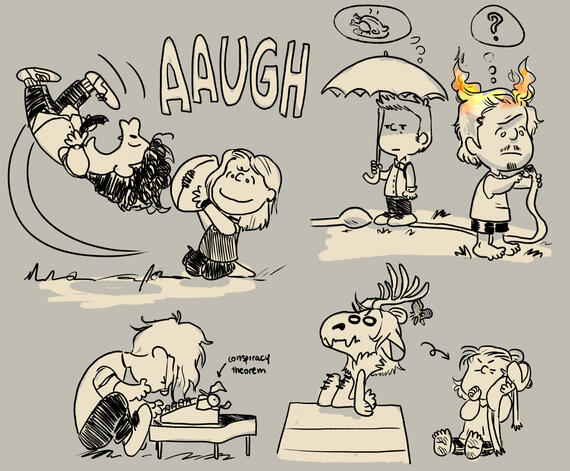
Damiano e Michelangelo Serpico are cousins of Monster-Fanatics family who descent from Marsilio's bloodline. Damiano is a conspiracy theorist and expert networker, Michelangelo had the unlucky fate of becoming what is categorized as "Chosen One". A paladin of some sort, with "great destiny" yadda yadda.
Angela Carboni is probably the only braincell (Damiano and Capusso share the other) and she's the Competent Woman every group needs. She has a morally dubious past and she's incredible with guns.
Disclaimer: I have no more than basic knowledge of historical notions, uses and costumes of the end of the 18th century and the beginning of the 19th. I apologize for any clear inconsistency, this backstory is just meant to be extremely dramatic for no reason than to stay on topic with some vampires' extremely dramatic stories.
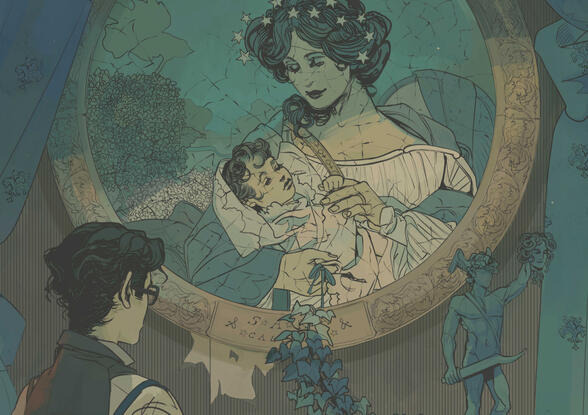
SPOILERS AHEAD - aka no details of the following backstory has actually emerged in game.
1775, Bologna. An unfortunate child from a fairly rich and powerful family (so, not that unfortunate) is named after his grandfather, Marsilio.
1799. This unfortunate child, being the second one, has grown up to become an unfortunate high ranked officer in the army. He's quite skilled in hand-to-hand combat but quite terrible with firearms (he wishes sword fighting was still the main thing).
He's rarely home, but his wife Sara is excitedly waiting for a child. She's been having an agreement with her distant husband - they're free to do as they please with their own time as long as they keep the marriage facade up. It's easier when the marriage is a planned one and you only meet a couple times per year. The child will settle down any bureaucracy matter, and the mostly independent Sara wouldn't mind some company at home. The child turns out to be healthy even after a difficult pregnancy, but Sara's conditions worsen in the following months. She finds solace in dubious acquaintances, while her husband is often required to leave the service to look after her and their baby.
1800. One of Sara's dubious acquaintances, Maria, turns out to be undead. Sara turns out to be nothing less once Maria volunteers to end the woman's pain. Mars turns out to be in trouble as his late wife attempts and actually succeeds to kill him.
Maria turns out to have planned this little charade to get both money and a bright new bodyguard once she offers the dying soldier her own blood.
1800/1810. To sum up: Mars is promoted to executioner (at least he can use longswords now). With the help of another vampire serving under Maria, he manages to have his child Calliope adopted by his older brother. He's going to miss her but she's going to live for a reasonable amount of human time. Maria grows to trust his bodyguard enough to clear her intentions. Mars unreasonably decides to study Dark Magic tm to reasonably end Maria's little monarchy. Gets a little out of hand by killing the vampire three times at once and burning off a whole wing of his house but could be worse.
1812. Mars' enthusiasm seems quite contagious, and he soon manages to organize a small group of dissatisfied vampire servants of abusive vampire sires. Their little mostly pacific academy gets some negative attention (Mars' occult studies are of no help) and more powerful vampires agree to put things back in their proper order. This choice turns out to be quite a poor one, resulting in the second and definitive death of Mars' associates and students. Mars puts good use to his loyal longsword, and to his executioner title, to settle the score. Those vampires wishing for order get a bad case of head loss instead, and the remaining eventually manage to exile the now feral headsman.
Silver chains with holy crosses, sealed coffin, an island in the middle of a river in the middle of nowhere...no way he can get back! No way he can get back, right?

1980 ca, Siberia. He did get back. 170 years later, a delicious expedition had the bright idea to awaken a 'demon', offering him the chance to avenge himself in exchange for a very specific list of favors.
You see, 170 years are a LOT of years to hold a grudge, and enough to realize how endless discourse can ruin many lives (and deaths) while still being pointless.
"I'll pass, thank you kindly." Mars would have replied if his throat was still in place, and to solve the 'starving for 170 years to the point of turning into a pool of very well conserved old blood' problem, he drank every single human in range. The providential snack after a long nap, right?
The snack put up a righteous fight, though, and Mars needed some more time to recover from waking up. A local family was kind enough to offer him a proper bed to rest and a reasonable amount of blood. He never learnt the language but sure made himself helpful, proving to be great at hunting (the sword was a weird weapon to use but effective nonetheless) and against wild animals.
He eventually got out of their hair, and traveled back to Italy.
1980s. Mars managed to track an heir, and worked his way in the old man's inheritance, which counted a beautiful but not so well preserved academic library in his hometown, Bologna.
He's lived there since, moving only in summer to visit that kind family in Siberia.
1990s. Constantly looking for funds for the restoration of his library, he splits his work between university activities and monster hunting work. Not every not-natural being is directly dangerous or deliberately harmful, so Mars tries to intercept any case that could end peacefully for the haunted as well for the haunting presence.
1992, Siberia. Mars first encounters a peculiar creature, who is neither a vampire nor a werewolf. Finds out the fellow cryptid isn't always 8ft tall and covered in blood and snow. Name's Mikolash, no proper housing nor social skills. Since the two managed not to kill themselves and actually got along pretty well (in Mars' opinion, which is always questionable), Mars attempts to have Mika join his hunting team (counting one member only for now).
The unenthusiastic cryptid eventually agrees to travel to Italy and...disappears as soon the train ends its run. Mars is (not so) sure a new creature in town won't be too much of a trouble.
For once, he's sort of right, and Mika occasionally passes by the library (once in like 5 years).
2000s. Times are changing and Mars is still figuring out how to pay his taxes properly. It's kind of hard when half of your properties belongs to a museum or is already in one. He unsuccessfully attempts to take a pair of boots back from an exposition, and gets arrested due to incorporeal complications.
The hunting team grows as years pass by - half of it has had unfortunate vampire encounters, most of which involves the librarian himself, who would rather not talk about his drinking problem.
In order to work a socially acceptable solution out, Mars gets in business with a local doctor who happens to be a vampire from France.
Jean Gabriel brings carefully packed and fresh blood bags from his hospital, and Mars...is quite happy! No more accidental biting! Wait, wasn't it supposed to be an exchange of goods?
And why has Mars never mentioned it until late? What kind of shady matters are discussed when the librarian leaves for 'groceries'? Angela, one of the first addition to the team, is sure no good will come from this - it's unsure if her Jean-hate comes from something personal or a french prejudice (also personal).
2020 ca. The library palace gets some restoration and upgrades, with the help of charities from very generous old ladies (local book club and Mars fanclub), and Damiano (ever tired hunter and unfortunate Mars' heir). An armory and infirmary are added, as with an occult library and panic room.
The hunting team is more active than ever, and even Mika seems to be more present. Mostly.
When not working on a case, Mars spends his days between the library and sports for over 40s (he and GG (Giangiuseppe) are in the same boules team). Nights are quite long, especially when there are groceries to get, but Mars always falls asleep at 3 o'clock and wakes up at 10. In a much-more-comfortable-than-a-coffin bed (he's...claustrophobic).
Extra facts. His full vampire form is still affected by the exile years, showing as a ghost of blood and bones in reflections. He seems to prefer blood magic to bites in combat, as the latter can get easily out of hand due to his awful thirst. Mars can only drink human blood, as a matter of his curse, and as it's the only one compatible with his everlasting still-beating probably-dark-magic-based heart. Silver and crosses, or wooden stakes are not effective against him anymore, while sunlight has never been a problem from the start. Still gets bad sunburns. He can pass through walls and objects, and has recently remembered how to fly. Watch out for doors since he does not remember to open them for you when he passes through. Accidental lounging also figures between his "many" powers.
Gallery
Let's deposit here all the amazing (and confusingly stupid) pieces of art that compelled and intrigues you enough to check out this carrd to find out more!


about the artists
Caemiel and Jonesylium of the two different pantheons of artists are close friends that have been cursed with the unavoidable need to get attached to characters and situations they jokingly create out of one-shots and silly games and consequently expand their stories starting from two memic characters into fully explainable and interconnected universes.
They both dabble in writing and, as artists tend to, have a very imaginative and creative mind which forces them to get things wildly out of hands.
Caemiel prefers to stick to the pittoric side of creation, specializing in stunningly detailed tarots that vaguely recount the stories of these characters, whereas Jonesylium generally writes and limit their artistry to portraits and to fleshing out characters, in the Ever Growing universe that it is Myths and Monsters.
They like to think their friends are intimidated by this unrelenting stream of new stories, but they are probably just concerned for their mental stability. This could not stop either Jonesy or Caemi, or the curse (they wouldn't even if they could).
Caemiel
Jonesylium